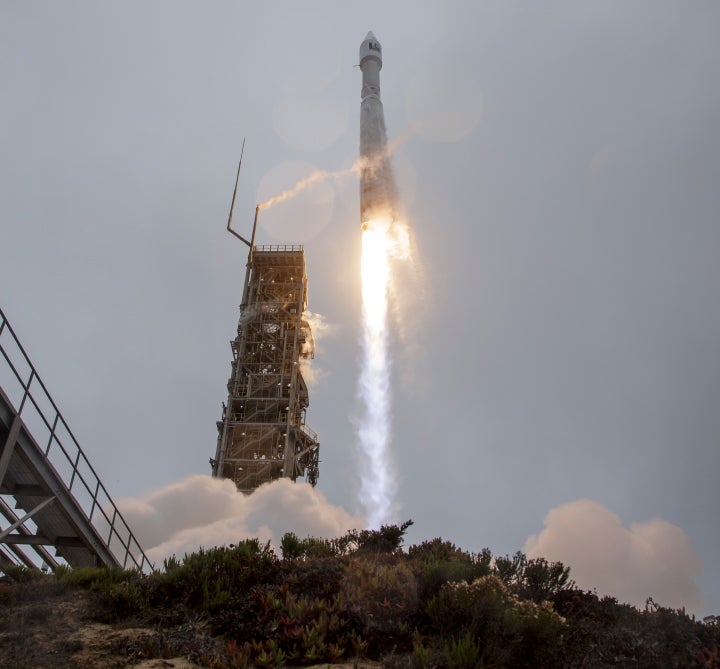
Meanwhile the inaugural flight of ULA’s much anticipated Vulcan Centaur rocket, which had been scheduled for this year, was delayed until 2022 so its customer, Pittsburgh-based Astrobotic Technology, can work through electronics shortages that have stalled completion of its Peregrine lunar lander.
The COVID-19 pandemic “presented a lot of problems for the entire space supply chain,” says Astrobotic’s CEO John Thornton. “We’re just doing the best we can.” The company is developing a series of landers for commercial flights to the moon. The debut mission onboard Vulcan is part of NASA’s Commercial Lunar Payload Services program and includes payloads from Mexico’s and Germany’s space agencies, as well as several commercial customers.
Early in the pandemic, ULA officials say, the company stocked up on as many components as possible to try to head off potential shortfalls that would directly impact its rocket manufacturing and launch business. The company has enough semiconductor chips to last several months and says it hopes deliveries will resume before supplies run out.
The supply chain issues impacting the space industry have been slow to emerge as the pandemic’s lengthy duration has gradually erased the temporal advantage that most launches had because of their years of preexisting, prepandemic preparations. Despite COVID, 114 orbital launches took place in 2020—104 of which did so successfully—tying 2018 for the highest number of orbital launches worldwide since 1990. The missions included two human spaceflights by SpaceX—the first from the U.S. since the end of the space shuttle program in 2011.
Now, however, the effects of the pandemic are becoming more severe as stockpiles run low and raw materials (as well as workforces) remain scarce.
While it will not help the immediate supply problems, the Department of Defense is taking steps to mitigate future microchip shortages, whether caused by a pandemic or some other global calamity. On August 23 the agency awarded a contract to Intel to support the first phase of a project to restart the long-languishing capacity for commercial chip manufacturing in the U.S. Intel plans to work with IBM, Cadence Design Systems, Synopsys and other companies under the DOD’s Rapid Assured Microelectronics Prototypes–Commercial program. The award follows Intel’s announcement in March that the company intends to invest up to $20 billion to build two new computer chip factories in Arizona to serve U.S. and European markets.
“The COVID-19 pandemic and resulting economic crisis have shown [that] structural weaknesses in both domestic and international supply chains threaten America’s economic and national security,” wrote White House officials in an announcement about the release of a June 2021 report on supply chain issues and U.S. manufacturing.
Congress is currently considering legislation that would provide seed funds for other U.S. microelectronics manufacturing projects.
“As with everything we’re experiencing in life, things are harder in COVID than they were outside of COVID,” NASA’s Mars Exploration Program director Eric Ianson told the Mars Exploration Program Analysis Group, an independent scientific advisory committee, on September 27. “We are seeing things … across all of our missions at NASA. Some are impacted more than others. Sometimes it’s things related to supply chain because there are assets being used for other things, not just our space missions,” he said. “Until the pandemic is fully under control, I think we’re going to continue to see impacts.”
“We are managing the impacts better today than we were when the pandemic began,” Ianson added. “I expect we’re going to continue to get better at doing that as we continue to ‘normalize’—for lack of a better term—working in this environment.”
Comments
Post a Comment